
How to Litter Train a Kitten
Quick answer: Start at about 3 weeks of age, with a low-sided tray and a sand, wood or paper-based litter. Put the kitten in the tray after sleeping or eating, show her the litter with one of her paws, and most kittens are toileting independently by about 5–6 weeks. Our Cat Litter Calculator works out the boxes and litter your household needs.
Litter training is mostly the kitten’s idea. Cats are born wanting a loose surface to dig in, and many kittens learn simply by watching their mother. Your job is smaller than you might expect: the right tray, the right first litter, and a few well-timed lifts into the box. This guide covers when to start, what to buy, the teaching steps themselves, and the cleaning routine that keeps a new habit from unravelling.
When should I start litter training?
Provide a litter tray from around three weeks of age. That is when kittens are moving around well enough to reach one, and it is the start of the age at which toileting becomes something they do for themselves rather than something their mother does for them. The tray goes down before it is needed, so it is simply part of the room when the moment arrives.
Many kittens learn how to use the tray simply by watching their mother, and need no teaching at all. By about 5–6 weeks, kittens can toilet for themselves, without relying on their mother. So the whole training window is short — roughly weeks three to six — and most of it is the kitten’s own development arriving on schedule.
What tray does a kitten need?
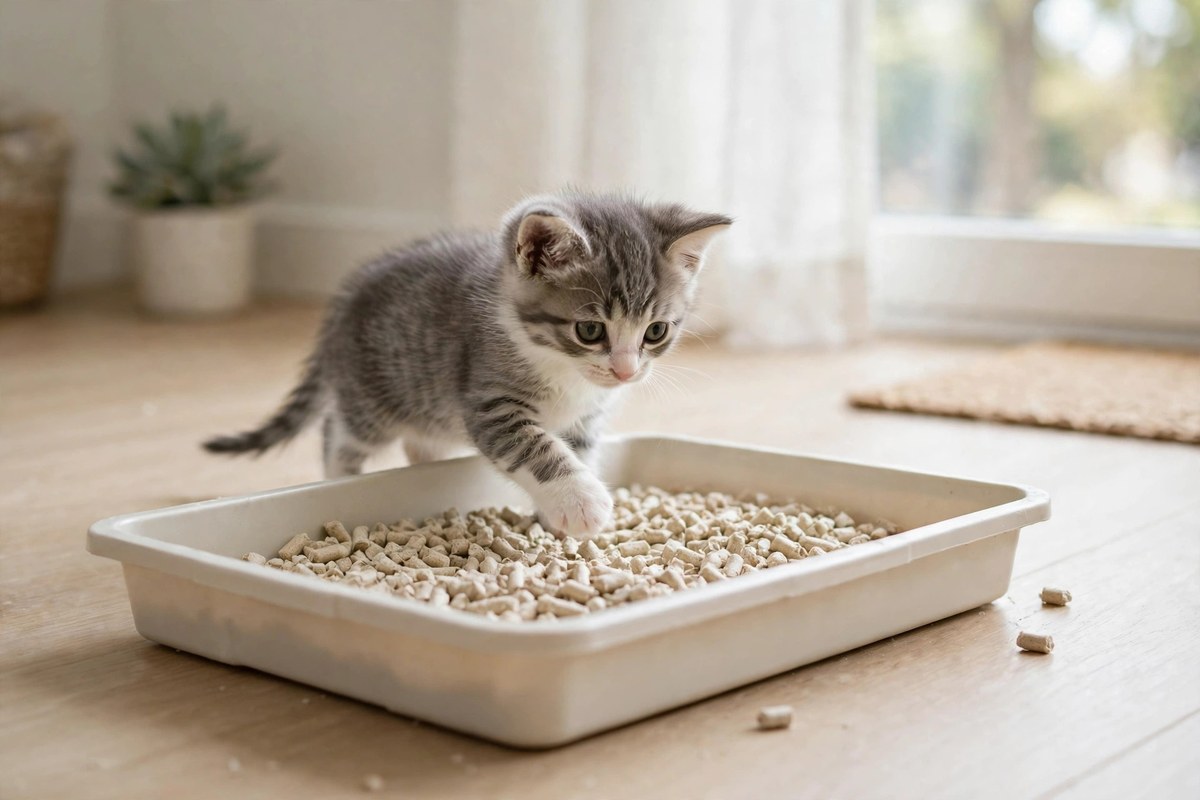
A low-sided one. Kittens — like elderly cats — need boxes with low sides, so they can step in and out without climbing or jumping. To a three-week-old kitten, the wall of a standard adult litter box is a cliff face, and a kitten who cannot get in cannot use it, however good her intentions. A shallow tray she can walk into beats a perfect box she cannot enter.
Put the tray where she already spends her time, in a quiet spot she can reach at all hours. In the first weeks that usually means near the nest area, not across the house: a tiny kitten does not have the range, or the planning, to travel far when the need arrives.
What litter is safe for a young kitten?
Start with a sand, wood or paper-based litter, rather than clay. The reason is kitten behaviour: some young kittens try to eat the litter, and the non-clay litters are the safer starting point while that phase passes. Silica gel litter should not be used for kittens under eight weeks of age at all.
More generally, for any cat younger than six months, use a litter specifically marked as safe for kittens. Once she is older and the litter-tasting phase is behind her, the full range of litters opens up — and the Cat Litter Calculator covers the main types and what each one costs to run month by month.
How do I teach a kitten to use the tray?
The steps are few, and gentle. Stand the kitten in the tray — the best times are after sleeping or after eating, when she is most likely to need it — and use one of her forepaws to scratch at the litter, showing her what the surface is for. That small demonstration, repeated at the right moments, is the heart of the training.
For very young kittens who cannot yet toilet on their own, there is one more step: massage the area under her tail gently with a wet wipe or a damp ball of cotton wool, the way her mother would with her tongue. That stimulation is what triggers toileting until about 5–6 weeks, when she can go by herself.
And leave a small amount of soiled litter in the tray rather than changing every last grain. It acts as a scent reminder of what the tray is for — a signpost, in the only language a three-week-old reads fluently. Between the paw-scratch demonstration, the timing, and the scent cue, most kittens connect the dots within days.
Where should the kitten’s tray go?
Quiet, reachable, and hers. A tray in a calm corner near where the kitten sleeps and plays will be used; a tray beside a roaring washing machine, or up a flight of stairs, will be bypassed by a kitten who cannot hold on long enough to reach it. Keep it away from her food and water — cats prefer the two well separated — and keep the route to it open around the clock, because a tray behind a door that closes at night is only a part-time tray. As she grows and ranges further, the tray can move with her, a little at a time, toward its permanent spot.
How many trays does a kitten need?
The household rule is n+1: one box per cat, plus one spare. A kitten joining a one-cat home moves the household target to three boxes, in different spots, and her own first tray counts toward that total as she grows into the full setup. Our guide How Many Litter Boxes Do I Need? explains the rule and the placement in full, and the Cat Litter Calculator works out what the extra box does to your monthly litter bill.
How do I keep the kitten’s tray clean?
Scoop at least twice a day — a dirty tray is the most common reason a cat of any age decides to go somewhere else. Completely clean the tray out every 2–4 weeks with clumping litter, and weekly with non-clumping litter. For a kitten still in training there is one deliberate exception to the full scrub: leave a little soiled litter behind at changes during the first weeks, as her scent reminder, rather than returning the tray to neutral.
Use the Cat Litter Calculator
Enter your cats, boxes and litter type to see your monthly usage in pounds, bags and cost — and what a new kitten adds to it.
Use the calculatorMistakes to avoid
- Starting with an adult box. High sides a kitten cannot climb are the most common reason a “failed” training was never really tried. Low sides first.
- Starting with clay or silica litter. Young kittens taste litter. Begin with sand, wood or paper-based litter, and keep silica gel away until she is over eight weeks.
- Scrubbing away the signpost. During training, a little soiled litter left in the tray is the reminder that teaches her. Total freshness can wait a few weeks.
- Putting the tray far away. A three-week-old has a short range and a shorter warning time. Near the nest first; move it gradually later.
- Expecting independence too early. Kittens toilet by themselves at about 5–6 weeks. Before that, the tray is practice, and her mother — or a wet wipe — is still part of the process.
Litter training questions
How long does litter training take?
The tray goes down at about 3 weeks, and by about 5–6 weeks kittens can toilet for themselves. Most kittens learn within that window — many simply by watching their mother — with placement after sleeping or eating and the paw-scratch demonstration speeding things along.
What if my kitten eats the litter?
That is exactly why the starting litter matters: some young kittens try to eat litter, so begin with a sand, wood or paper-based litter rather than clay, avoid silica gel until she is over 8 weeks old, and use a litter marked safe for kittens while she is under six months. If she keeps eating it rather than just tasting it, mention it to your vet.
Can a 3-week-old kitten use a litter tray?
Yes — a low-sided tray should be provided from around 3 weeks of age. She will not be independent yet: kittens toilet by themselves at about 5–6 weeks, and before that their mother, or you with a wet wipe or damp cotton wool, stimulates them. The tray is there from 3 weeks so the habit forms as the ability arrives.
Should I use clumping litter for a kitten?
Not at the start. Begin with a sand, wood or paper-based litter rather than clay, because some kittens try to eat the litter, and for a cat under six months use a litter marked as safe for kittens. Once she is older, clumping litters are fine — their cleaning rhythm is a full change every 2–4 weeks.
This guide supports the Cat Litter Calculator. More guides — on measuring for a crate, water needs, pet years and senior care — are listed on the blog index.