
Can Cats Eat Peanut Butter?
Quick answer: Not toxic, but a poor treat choice. No poison-control reference lists peanut butter as toxic to cats, so a lick is not an emergency. The problem is the maths: one tablespoon carries about 94 kcal, which is roughly four days of treat budget for an average cat, for a food that gives her nothing she needs. If it happens at all, a pea-sized smear is the serving. Work out your cat’s budget with our Pet Calorie Calculator.
Peanut butter is the treat people reach for when a dog needs distracting, and it is natural to wonder whether the cat can join in. The answer is not the emergency some owners fear. Peanut butter is not a poison for cats. It is something quieter and, for a cat, almost as decisive: a calorie problem. This guide covers what peanut butter actually costs a cat, what is worth checking on the label, and the one label ingredient that matters enormously in a house with a dog. The feeding maths behind the amounts sits in our Cat Food Calculator.
Is peanut butter toxic to cats?
No. Peanut butter does not appear on the published lists of people foods pets should never eat, and no veterinary poison reference classes it as toxic to cats. A cat who has licked peanut butter off a spoon, or cleaned a smear off a plate, has not had a poisoning emergency, and there is nothing to counteract and no symptom watch to start.
That is worth stating plainly, because peanut butter sits in a confusing spot in pet advice: it is famous in dog care, and some of the warnings attached to it belong to dogs, not cats. The xylitol section below untangles the biggest one. For a cat, the verdict is narrower. Peanut butter will not poison her. It will simply spend her treat budget at a rate almost no other kitchen food can match.
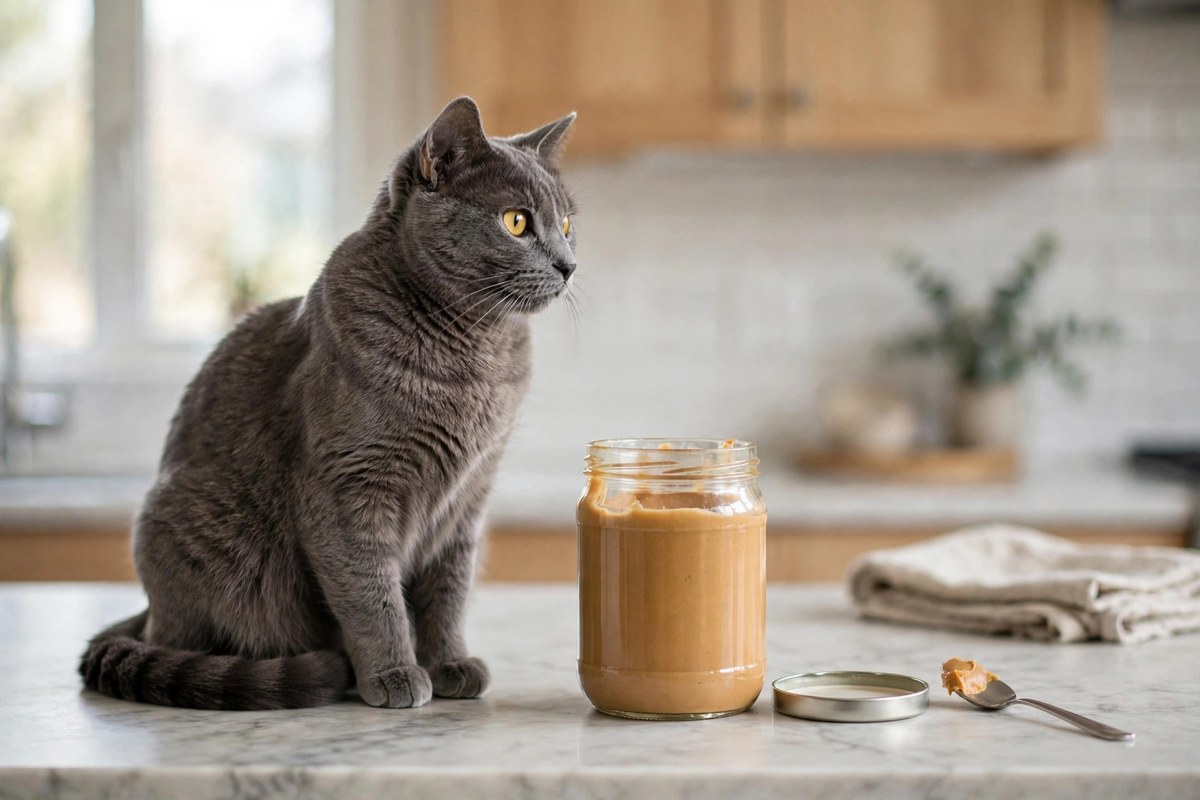
Why is peanut butter a poor treat for a cat?
Because of what a spoonful costs. On the standard food-composition figures, one tablespoon of peanut butter (16 g) carries about 94 kcal. Now set that against a cat’s day. A neutered 4 kg (about 9 lb) cat needs roughly 238 kcal a day in total, and the treat rule, treats of every kind under 10% of daily calories, gives her a treat budget of about 24 kcal. One tablespoon of peanut butter is roughly four days of that budget, spent in a single lickable spoonful, on top of full meals.
And what does she get for those calories? Nothing she is short of. A complete cat food is formulated to cover her needs in full, and peanut butter is a food made for people, energy-dense, built around fat, and portioned for people. A food can be harmless and still be a bad bargain, and peanut butter is the clearest example in the kitchen: the same pleasure, for the cat, is available from treats that cost a tenth as much of her day. If your cat is already carrying extra weight, this is the first extra to cut. The Cat Weight Calculator will show you where she stands.
What should I check on the label?
Two things, and the first is the serving size. Peanut butters vary, and the calories are printed per serving: compare that number with your cat’s treat budget, not with your own sense of a spoonful. The second is the ingredient list itself, not because ordinary peanut butter hides a cat poison (it does not), but because sweetened and flavoured versions vary widely, and the next section covers the one sweetener that changes the picture for another member of the household.
The simplest label habit is this: if you cannot see, in numbers, how a spoonful fits inside roughly 24 kcal of treats, the spoonful is too big. For peanut butter, it almost always is, which is why the practical serving, if it is offered at all, is a pea-sized smear on a fingertip, not a spoon.
A note for homes with dogs: xylitol
If you also have a dog, this section is the important one. Some peanut butters, usually the sugar-free ones, are sweetened with xylitol, also listed as birch sugar. For cats, the position in the poison-control references is clear: xylitol does not cause serious problems in cats, and cats are not at risk of the blood-sugar crash or liver injury that xylitol causes in dogs. So this is not a cat warning, and it should never be written as one.
For dogs it is a genuine poison, one of the most dangerous in the kitchen, and peanut butter is one of the foods it hides in. If a dog shares your house, check any peanut butter for xylitol before it is offered to him, and store sweetened jars where he cannot reach them. If a dog has eaten a xylitol product, that is an emergency. Our Dog Ate Xylitol page covers the signs and the timing. Your cat, meanwhile, is safe from this particular danger; her peanut butter problem remains the calories.
What can I give my cat instead?
Almost any treat made for cats does the same job at a fraction of the cost to the budget. If it is a people food she is hoping for, a bite of banana fits easily inside the treat rule, our guide to bananas covers the amounts, and a little plain cooked egg is on the standard healthy-snack lists for cats, as our egg guide explains. Both give her the shared moment without spending four days of treats on it.
And if the peanut butter was really about giving her something to lick and work at, a few minutes of play with a wand toy spends nothing at all. Treats are for pleasure, not nutrition, so anything she genuinely enjoys does the job.
Use the Cat Food Calculator
Turn your cat’s daily calories into cups, cans or grams of her actual food, and see exactly what is left of the day for treats.
Use the calculatorThe short version
Peanut butter: not toxic, just expensive. It will not poison your cat, but one tablespoon holds about 94 kcal, roughly four days of treat budget, and gives her nothing her food is missing. A pea-sized smear now and then is the whole serving. Check labels for serving size, and if a dog lives with you, check them for xylitol for his sake, not hers.
Peanut butter questions
Is peanut butter poisonous to cats?
No. Peanut butter does not appear on the published lists of people foods pets should never eat, and no poison-control reference classes it as toxic to cats. A cat who has licked peanut butter has not been poisoned. The case against it is calories, not toxicity: it is one of the most calorie-dense foods in the kitchen, and a cat’s treat budget is small.
How much peanut butter can I give my cat?
A pea-sized smear at most, and only occasionally. One tablespoon of peanut butter carries about 94 kcal, and the whole day’s treat budget for a neutered 4 kg (about 9 lb) cat is roughly 24 kcal, so a single spoonful is about four days of treats at once. Treats of every kind together should stay under 10% of her daily calories.
Can cats eat peanut butter with xylitol in it?
For your cat, xylitol is not the danger it is for dogs: the poison-control references state that xylitol does not cause serious problems in cats, and cats are not at risk of the blood-sugar crash or liver injury it causes in dogs. The cat reason to skip peanut butter is the calories. But if a dog lives in your house, xylitol-sweetened products are a genuine emergency risk for him. Keep them well out of his reach.
My cat licked peanut butter off a spoon. Should I worry?
No, a lick is not a poisoning, because peanut butter is not toxic to cats. What she has spent is treat budget: even a generous lick can carry a day’s worth of treat calories, so skip the treats for a day or two and let the budget recover. If she seems unwell in any way, call your vet. That advice stands for any food eaten in quantity.
This guide supports the Cat Food Calculator and the Pet Calorie Calculator. Sister guides in the same series: Can Cats Eat Bananas?, Can Cats Eat Cheese?, Can Cats Eat Dog Food?, Can Cats Eat Eggs? and Can Cats Eat Strawberries? More guides are listed on the blog index.