
When Can Kittens Eat Wet Food?
Quick answer: From about 3.5 to 4.5 weeks of age. Weaning starts at around 3–4 weeks with a soupy gruel, most kittens are eating with little or no added moisture by 4–6 weeks, and weaning is complete by about 6–8 weeks. If you are not sure how old your kitten is, our Kitten Age Calculator works it out from her weight and signs.
A kitten’s first weeks run entirely on milk, and then, quite suddenly, they don’t. Weaning is the bridge between the two, and it has a shape: a first saucer at around a month old, a few weeks of gradually thickening food, and a kitten who eats proper meals by about two months. This guide walks the timeline — when the first wet food can go down, what goes in the saucer, how the gruel stage works day by day, and how long kitten food should stay on the menu afterwards.
When can kittens first eat wet food?
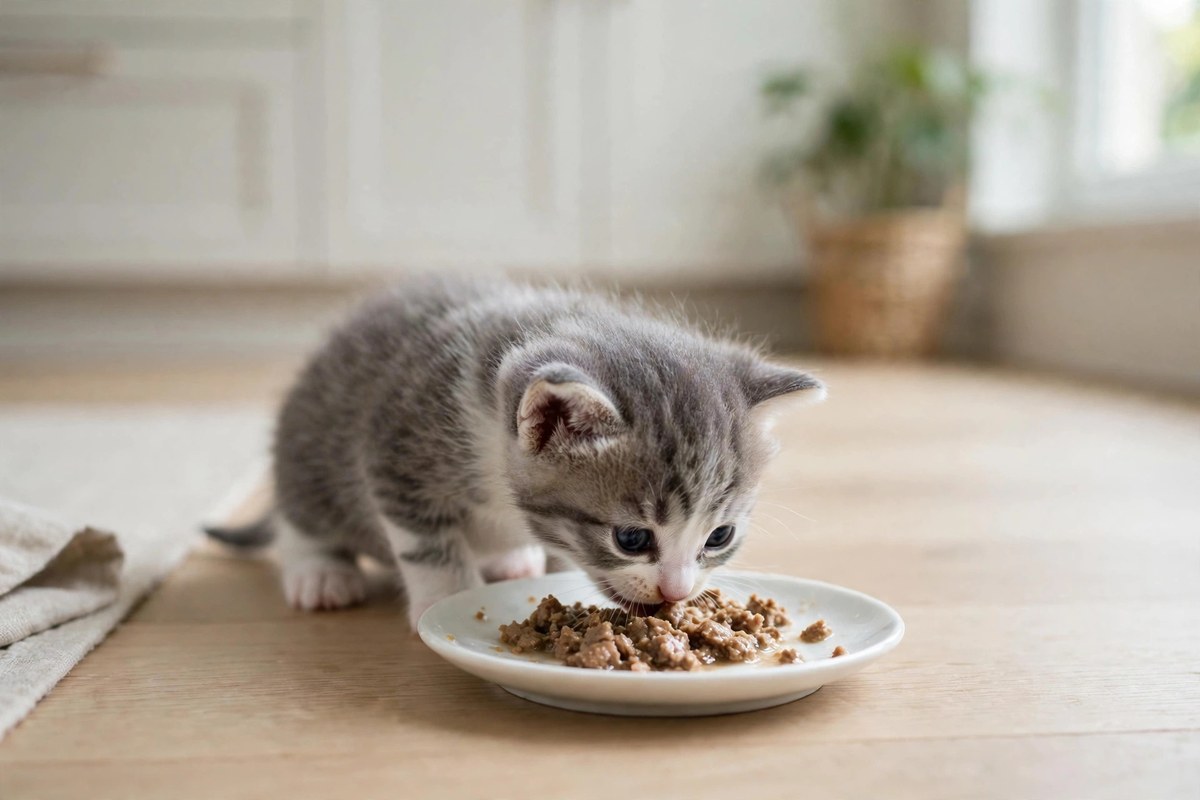
Weaning — the move from milk onto solid food — can usually start at around 3–4 weeks of age, and kittens should begin eating solid food at about 3.5 to 4.5 weeks. The first food is not a chunk of anything. It is a thin gruel, closer to a soup than a meal, served on a flat saucer at floor level where a wobbly kitten can reach it.
The signal that the timing is right is the kitten herself. Kittens of this age start showing interest in food, and once the introductions begin, most learn to lap from the saucer within one to three days. A kitten who is not interested on day one is not behind — she is simply at the early edge of the window, and the saucer keeps being offered.
What should a kitten’s first food be?
Wet kitten food is the usual starting point — or dry kitten kibble soaked in water until it is thoroughly soft and moist. Either way, it should be kitten food, formulated for growth, not adult cat food. That choice outlasts weaning by months: kittens stay on kitten food until 12 months of age, long after they are eating solid meals.
Serve it on a very shallow saucer or plate. To a four-week-old kitten, the rim of an ordinary bowl is a wall, and a kitten who cannot comfortably reach the food will not eat much of it. A flat dish, a small amount of fresh food, and a spot she can reach without climbing is the whole setup.
How does the gruel stage work?
Start by mixing milk replacer with a small amount of kitten food to make a gruel, and put it in a flat saucer. Carefully dip the kittens’ noses into the mixture two or three times a day, until they begin to lap — that usually takes one to three days. The nose-dipping feels odd, but it is how a kitten who has only ever suckled learns that this new smell is food.
Then thicken it, gradually. Reduce the amount of milk replacer or added moisture a little each day, so every day’s saucer is slightly less soupy than the last. By about 4–6 weeks of age, most kittens are eating the canned or dry food with little or no moisture added at all. The change is a slope, not a switch — there is no single day when gruel stops and “real food” starts.
How often should a weaning kitten eat?
Feed at least four times a day — or, ideally, leave food available so the kittens can eat little and often, as much as they want. A weaning kitten’s stomach is small and her growth is fast, so frequent small meals suit her far better than two large ones. Whatever pattern you choose, the food should be fresh at each serving and the saucer shallow enough for her to eat from comfortably.
Should I offer wet food, dry food, or both?
Starting with wet kitten food, or thoroughly soaked kitten kibble, is the usual recommendation. But offering both wet and dry food as weaning progresses has a benefit that lasts well beyond kittenhood: kittens who meet different textures early are more willing to accept different textures later in life, which makes every future diet change easier.
So the practical pattern is to begin with the wet food or gruel, then let soaked — and later dry — kitten kibble join the menu alongside it, rather than swapping one food for the other overnight. By the end of weaning she has met both, and neither is strange to her.
What does the weaning timeline look like, week by week?
Around 3–4 weeks: weaning can start. The first saucer of gruel goes down, noses are dipped two or three times a day, and the kittens begin to lap, usually within one to three days.
About 3.5–4.5 weeks: kittens begin eating solid food proper — still soft, still shallow-saucer food, but recognisably a meal rather than milk with something in it.
About 4–6 weeks: the added moisture is reduced day by day until the food is eaten with little or none. The gruel stage ends here, quietly.
About 6–8 weeks: weaning is complete — almost complete by seven weeks, and done by about eight. Every meal is solid kitten food, and milk is behind her. Kitten food itself continues until 12 months.
When is a kitten fully weaned?
By about 6–8 weeks of age. A fully weaned kitten eats solid kitten food at every meal and no longer needs milk, gruel or soaked food, though she may still nurse for comfort if her mother allows it — that is social, not nutritional. Fully weaned is not fully grown, though: the growing continues for most of her first year, which is why kitten food stays on the menu until 12 months.
As she grows, the amounts change even when the food does not. The Cat Food Calculator works out how much kitten food she needs at each stage. And if her age is a guess — as it often is with a rescued litter — the Kitten Age Calculator can pin it down from her weight and teeth, so the weaning stage you follow matches her real age rather than her estimated one. The Kitten Weight Calculator checks her weight against the expected range for her age, so you can watch the growing itself stay on track.
Use the Kitten Age Calculator
Work out your kitten’s age in weeks from her weight and signs, so her feeding stage matches her real age.
Use the calculatorWhat if I don’t know my kitten’s age?
Then wean by signs, not by the calendar. A kitten who is lapping confidently and eating the gruel well is ready for it to thicken, whatever her paperwork says; a kitten who cannot yet lap is not ready for dry food, whatever her paperwork says. Weight and teeth are the clues used to estimate an unknown kitten’s age — run them through the Kitten Age Calculator first, and the timeline above will usually fall into place around the answer.
Weaning questions
Can a 3-week-old kitten eat wet food?
Weaning can start at around 3–4 weeks, so a 3-week-old can be introduced to the first stage: a thin gruel of milk replacer mixed with a little kitten food, on a flat saucer. Solid food proper begins at about 3.5 to 4.5 weeks — the gruel is the bridge, not the destination.
What if my kitten won’t eat the gruel?
Keep dipping her nose gently into the mixture two or three times a day. Most kittens begin to lap within one to three days of the introductions starting. Offer it fresh, on a very shallow saucer, and let her meet it at her own pace across those first days.
When do I stop adding milk replacer?
Reduce the milk replacer or added moisture a little each day once she is lapping. By about 4–6 weeks of age, most kittens are eating the canned or dry food with little or no moisture added, and the gruel stage is over.
How long should a kitten stay on kitten food?
Until 12 months of age. Weaning finishes at about 6–8 weeks, but growing does not: foods formulated for kittens are made for that whole first year of growth, so keep them on the menu long after the gruel stage ends.
This guide supports the Kitten Age Calculator and the Cat Food Calculator. More guides — on litter boxes, water needs, pet years and senior care — are listed on the blog index.