
What Can Dogs Not Eat?
Quick answer: More everyday foods than most owners expect. Chocolate, grapes and raisins, xylitol, onions and garlic, macadamia nuts and alcohol can all poison a dog, and none of them has a safe amount you can work out at home. Raw yeast dough, raw meat and raw eggs, milk and large amounts of salt belong on the list too. If your dog has eaten anything on this page, call your vet or an emergency animal clinic first, then read. The most common case, chocolate, has its own Dog Chocolate Toxicity Calculator.
Every kitchen holds two menus: yours, and the one your dog believes is his. Most people food is merely unsuitable for dogs, but a short list of everyday items is genuinely dangerous, a few of them in surprisingly small quantities, and some with signs that arrive days after the food is gone, when the connection is easy to miss. This guide works through the list food by food: what each one does inside a dog, the signs to watch for, and when those signs appear.
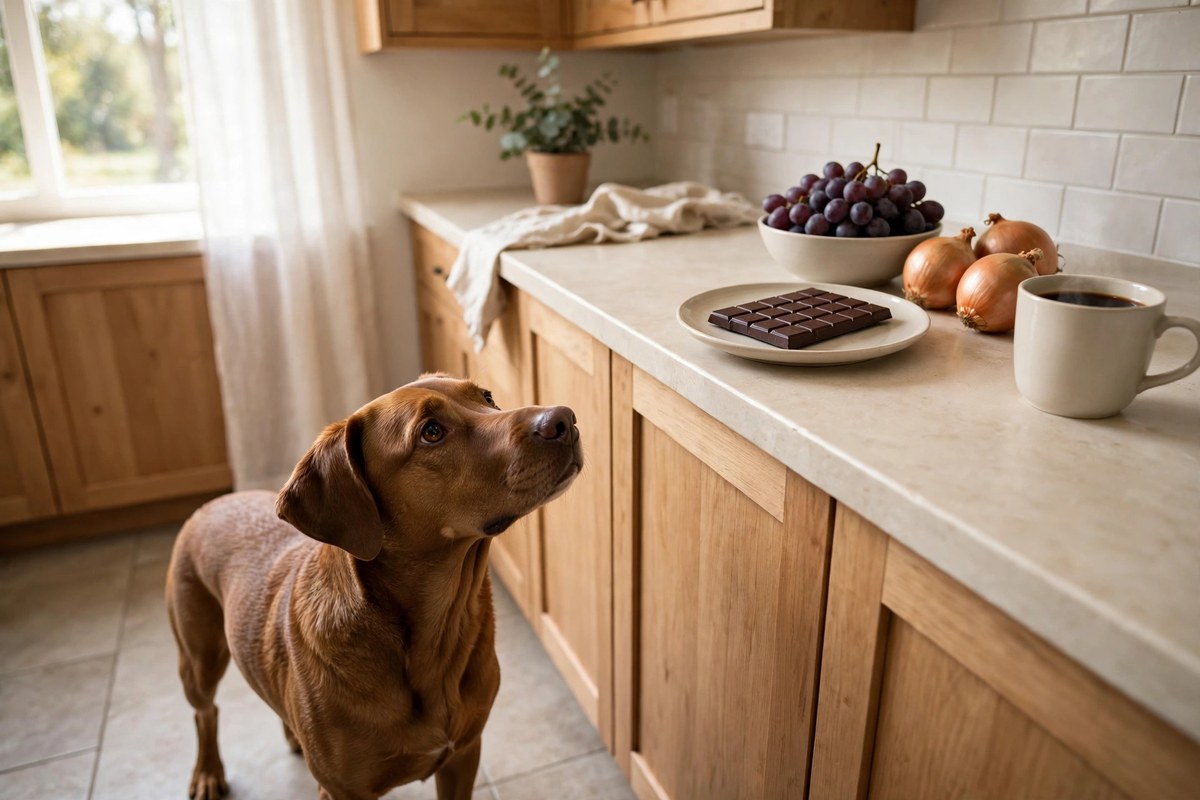
What makes a food dangerous for a dog?
A dog is not a small person. His body handles some very ordinary chemicals differently from yours, and the foods on this page are dangerous because of a specific substance his system processes badly, not because the food is “bad” in itself. That is why the list surprises people: grapes are a healthy snack for you and a kidney poison for him.
One rule covers the whole page. For the true poisons here, there is no safe dose to calculate at home, and this guide prints none. The response is always in the same order: call the vet first, then read.
Chocolate, coffee and caffeine
Never safe for dogs. Chocolate, coffee and caffeine products all contain methylxanthines, theobromine and caffeine, and in a dog these can cause vomiting and diarrhea, panting, excessive thirst and urination, hyperactivity, an abnormal heart rhythm, tremors, seizures and, at the worst end, death. Signs usually begin within 6 to 12 hours of eating.
Strength matters. Dry cocoa powder is the most concentrated source, then unsweetened baker’s chocolate, then semisweet and dark chocolate, then milk chocolate; white chocolate carries insignificant amounts. So the same weight of dark chocolate is a much bigger event than the same weight of milk. If your dog has eaten any of it, our Dog Chocolate Toxicity Calculator works out the danger level from the type and the amount, and the vet call comes with it, whatever the calculator says.
Grapes, raisins and currants
Grapes and raisins can shut down a dog’s kidneys. Poison references do not fully agree on which substance in the fruit does the damage, one lists it as unknown, while a newer veterinary chapter names tartaric acid, but they agree on the outcome: kidney failure, and no established amount that is safe.
The timetable is deceptive. Vomiting and diarrhea usually appear within 6 to 12 hours, and kidney failure develops within 1 to 3 days, so a dog can seem to be recovering while the real injury is still on its way. Our Dog Ate Grapes or Raisins page covers the signs in full; the action, as ever, is the phone call first.
Xylitol (birch sugar)
Xylitol is a sweetener found in sugar-free gum, candy, baked goods, toothpaste and some peanut butters. In dogs it triggers a rapid release of insulin, and the resulting crash in blood sugar can lead on to liver failure. The first signs, vomiting, tiredness, loss of coordination, can start within 30 minutes, or be delayed by 12 to 18 hours when the xylitol came in gum, which slows absorption.
Check labels for “xylitol” or “birch sugar”, the same substance under two names. Our Dog Ate Xylitol page covers this one in full.
Onions, garlic and chives
The whole onion family damages a dog’s red blood cells. Onions, garlic and chives cause gastrointestinal irritation first and can lead to red blood cell damage. The cells break down faster than the body can replace them, and the dog becomes anaemic. The trap with this one is timing: the signs often take a few days to appear, so a dog can look completely well while the damage is under way.
Leftovers are the usual route, a sauce, a stew, a gravy, rather than a dog eating a raw onion. Our Dog Ate Onion or Garlic page covers the delayed signs and what to watch for.
Macadamia nuts
Macadamia nuts are a dog-only problem. Dogs are the only species in which illness from them has been reported. They cause weakness, depression, vomiting, tremors and an overheated body. Signs usually appear within 12 hours of eating and last approximately 12 to 48 hours. A dog who cannot stand properly after raiding a nut bowl still needs the vet call, not a wait-and-see.
Alcohol and raw yeast dough
Alcohol poisons dogs the way it poisons people, only faster and at far smaller amounts: vomiting, diarrhea, decreased coordination, depression of the central nervous system, difficulty breathing, tremors, abnormal blood acidity, coma and, at the worst end, death. There is no safe sip for a dog.
Raw yeast dough is alcohol’s double act. Swallowed dough keeps rising in the warmth of the stomach, causing gas and pain and, in the worst case, a ruptured stomach or intestine. As the yeast ferments, it produces ethanol, which is absorbed into the bloodstream. A rising loaf and a bottle of wine are, to a dog’s body, the same accident arriving by two doors.
Raw meat and raw eggs
Raw meat and raw eggs can contain bacteria such as Salmonella and E. coli, which can be harmful to pets and to the people handling their food. That risk is the main reason raw feeding ingredients belong on this page. Raw eggs carry a second, slower issue: raw egg white contains avidin, which destroys biotin, one of the B vitamins. Cooking destroys avidin. That is why cooked egg is a treat and raw egg is a list item.
Milk and large amounts of salt
Milk is an upset rather than a poison. Dogs do not possess significant amounts of lactase, the enzyme that breaks down lactose, so milk and milk-based products commonly cause diarrhea or other digestive upset. A lap of milk is not an emergency; it is a mess.
Salt is a matter of amount. Large amounts can produce excessive thirst and urination, or even sodium ion poisoning: vomiting, diarrhea, depression, tremors, an elevated body temperature, seizures and, at the worst end, death. A stolen crisp is not this; a tub of salt dough or a stock-cube binge can be.
What about bones?
Bones are not a poison, and they are not on the never-feed list above, but they are not a safe treat either. Bones can cause injury or blockage in the gut, and a dog who has swallowed a bone and is retching, drooling, off his food or straining needs a vet, not observation at home. If your dog chews bones, supervise the chewing and take the bone away once it is small enough to swallow in chunks.
What should I do if my dog ate one of these foods?
Call your vet or an emergency animal clinic now, before signs, not after them. Do not make your dog vomit unless a veterinarian tells you to. Note what was eaten, roughly how much, and when, and keep the packaging so you can read the ingredients over the phone. Poison helpline numbers are listed on our Disclaimer page.
One more danger is not a food at all: human painkillers. If your dog has swallowed tablets meant for people, that has its own emergency page, Dog Ate Ibuprofen, and the same rule applies: the call comes first.
Use the Dog Chocolate Toxicity Calculator
Dog ate chocolate? Work out the dose and danger level from the type and the amount eaten, and call your vet.
Use the calculatorThe short version
Chocolate, grapes and raisins, xylitol, onions and garlic, macadamia nuts, alcohol and raw yeast dough can poison a dog; raw meat and eggs carry bacteria; milk upsets; salt harms in quantity; and bones can injure or block the gut. None of the poisons has a safe amount to work out at home. Whatever was eaten, the vet call comes first and the reading comes second.
Dangerous-food questions
Can a dog eat just a little chocolate?
There is no amount of chocolate you can safely work out at home. How dangerous a piece is depends on the type, dark and baker’s chocolate are far stronger than milk, on how much was eaten, and on your dog’s size. Signs usually begin within 6 to 12 hours. If your dog has eaten any chocolate at all, use our Dog Chocolate Toxicity Calculator for the danger level and call your vet.
My dog ate a grape. What should I do?
Treat it as an emergency and call your vet or an emergency clinic now, even if your dog seems fine. Grapes and raisins can cause kidney failure, there is no established amount that is safe, and the early signs, vomiting and diarrhea, usually appear within 6 to 12 hours, with kidney failure following within 1 to 3 days. Waiting for signs wastes the safest window.
Are bones safe for dogs?
Bones are not a poison, but they are not a risk-free treat either: a bone can cause injury or a blockage in the gut. If your dog chews bones, stay and watch, and take the bone away once it gets small enough to swallow in chunks.
How soon do signs appear after a dog eats something poisonous?
It depends on the food. Xylitol can act within 30 minutes, though in gum the signs can be delayed by 12 to 18 hours. Chocolate usually shows within 6 to 12 hours. Grapes and raisins typically cause vomiting or diarrhea within 6 to 12 hours, with kidney failure 1 to 3 days later. Onion and garlic damage often takes a few days to show, and macadamia nut signs appear within 12 hours. Whatever was eaten, the call to the vet comes first. Do not wait for signs.
This guide supports the Dog Chocolate Toxicity Calculator and the emergency guides: Dog Ate Grapes or Raisins, Dog Ate Xylitol, Dog Ate Onion or Garlic and Dog Ate Ibuprofen. Poison helpline numbers are listed on our Disclaimer page.