
How to Measure Your Dog for a Crate
Quick answer: Measure your dog standing: length from the tip of the nose to the base of the tail, and height from the floor to the top of the head, or the ear tips if they stand higher. Add 2–4 inches to each number, then choose the smallest standard crate that clears both. Our Dog Crate Size Calculator does the adding and the matching for you.
You need two measurements, both taken with your dog standing: the length from the tip of the nose to the base of the tail, and the height from the floor to the top of the head, or the ear tips if they stand higher. Add 2–4 inches to each number, then pick the smallest standard crate that clears both. Here is how to take both without the errors that land most people with the wrong size.
What do you need before you start?
A soft tape measure is best. With only a stiff one, use string instead: run it along your dog, pinch the ends, then measure the string flat. Stand your dog side-on against a wall, and mark the nose and tail positions on it with a fingertip or painter's tape. Then measure between the marks with the dog out of the way. A helper and a treat make it far easier.
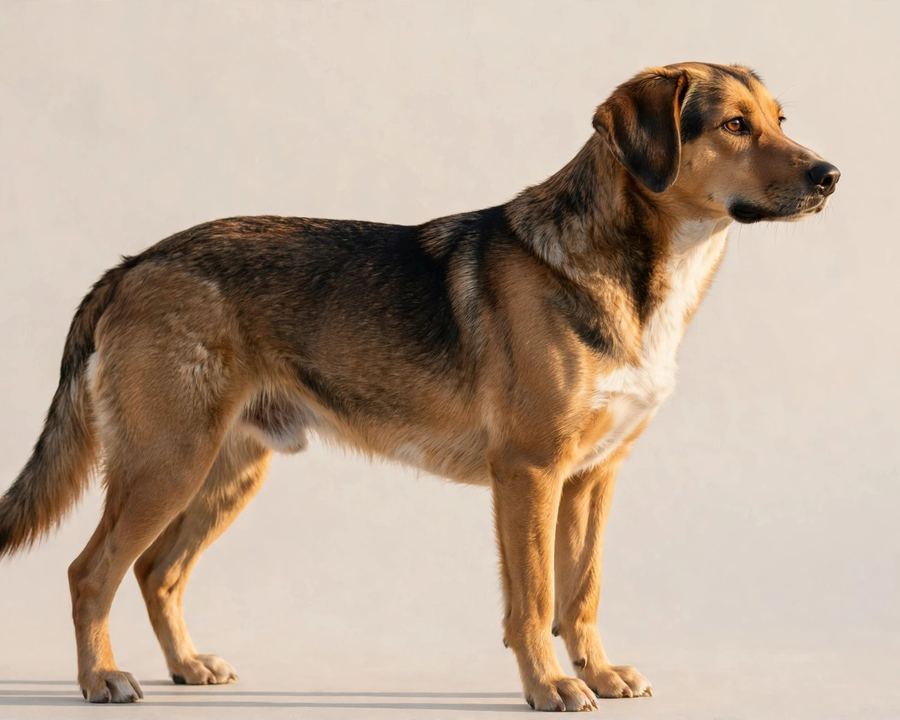
Measurement 1: length (nose to the base of the tail)
Length is one straight line from the tip of the nose to the base of the tail, where the tail joins the body.
Stand your dog in a natural position, head up and looking forward, and measure the body in one straight line:
- Find the base of the tail. Run a hand down your dog's back to where the tail joins the body. That point, not the end of the tail, is your back marker.
- Put the zero end of the tape at the tip of the nose.
- Read the tape at the base of the tail. If your dog won't hold still, mark both points on the wall and measure between the marks instead.
The tail itself doesn't count: it curls out of the way when a dog stands, turns and lies down. Measuring to the tip just adds inches the crate doesn't need.
Measurement 2: height (floor to the top of the head)
Run the tape from the floor straight up to the top of your dog's head. Two exceptions matter:
- Ears: if they stand higher than the skull, measure to the ear tips. They are what will meet the crate roof.
- Sitting: if your dog sits taller than they stand, take the sitting height and use that.
Measure the dog as they normally stand. A dog straining up toward a treat held overhead is taller than the dog who will use the crate.
How much growing room should you add?
Add 2–4 inches to each measurement. Raw measurements are not crate measurements. The extra 2–4 inches is the space that lets a dog stand without ducking and turn without scraping the sides. Standard crate guides sit at the generous end of that range, at about 3–4 inches. Our Dog Crate Size Calculator adds 4.
A quick example shows why both numbers matter: A typical Labrador measures about 32 inches nose to tail base and 27 inches tall. Add 4 inches: minimums of 36 long and 31 high. The 36-inch crate clears the length, but its typical height is only 26 inches, so it fails. The right buy is the 42-inch crate, and height decided it.
How do you match your numbers to a standard crate size?
Crates are sold by length, in eight standard sizes. Your length plus growing room names the smallest candidate; your height decides whether it actually works. Typical dimensions are below. Brands differ by an inch or so, so check the maker's own chart before you pay.
| Crate size | Typical size (L × W × H) |
|---|---|
| 18″ — XS | 18×12×14 in |
| 22″ — Small | 22×13×16 in |
| 24″ — Medium | 24×18×19 in |
| 30″ — Intermediate | 30×21×24 in |
| 36″ — Large | 36×24×26 in |
| 42″ — XL | 42×28×31 in |
| 48″ — XXL | 48×30×33 in |
| 54″ — Giant | 54×37×45 in |
Use the Dog Crate Size Calculator
Enter your two numbers and get the smallest crate that fits, plus which measurement decided it.
Use the calculator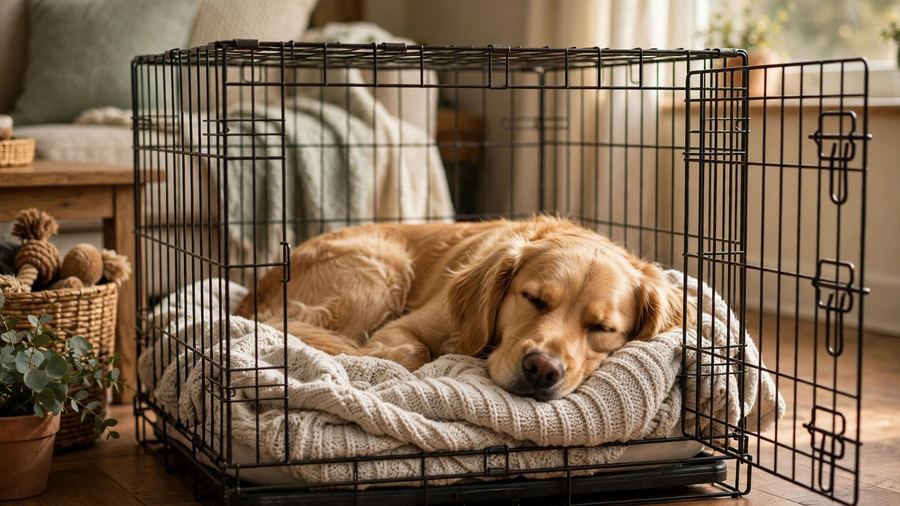
How do you test the fit before and after you buy?
Before the crate arrives, run the tape test: mark its floor dimensions on the ground with painter's tape and ask your dog to stand inside the outline, turn, and lie flat on their side. Two minutes with tape beats a return label.
Once the crate is home, repeat it for real: it passes if your dog can stand at full height without ducking, turn in a complete circle, and lie flat on their side, legs stretched. Crouching or failing to turn means too small, whatever the label said.
Mistakes to avoid
Most wrong-size crates trace back to the same few errors: measuring to the tail tip, measuring a curled-up dog, forgetting the ears, and choosing on length alone.
- Measuring to the tip of the tail. Always stop where the tail joins the body.
- Measuring a dog who is lying down or curled up. Both are standing measurements; a curled dog measures short.
- Forgetting the ears. If they stand above the skull, they set the height.
- Choosing on length alone. Height fails most often. It pushed the Labrador above up a size.
- Buying a crate "to grow into" without a divider. An oversized crate lets a puppy toilet at one end and sleep at the other, working against house training. Buy the adult size, shrunk with its divider panel, instead.
- Trusting the size label over the tape. Labels vary by an inch or so between brands, so check the maker's chart.
Crate measuring questions
Should I measure my dog standing up or lying down?
Standing, for both. A curled-up dog measures noticeably shorter than the same dog on their feet, and the crate has to fit the standing, turning version. One exception: if your dog sits taller than they stand, use the sitting height.
What if my dog won't stand still to be measured?
Don't chase the dog with the tape. Stand them side-on against a wall, have a helper keep them there with a treat, and mark the nose and tail-base positions on the wall. Then let the dog go and measure between the marks. String works too: lay it along the dog, pinch the ends, measure it flat afterwards.
Should I measure my puppy, or the adult they will become?
The adult. Buy for the size your puppy will reach (measure or look up the breed's expected adult size), and shrink the space with the divider panel that comes with most wire crates while they grow. It saves buying three crates in the first year.
My dog falls between two crate sizes. Which should I buy?
The larger one. If either dimension of the smaller crate falls short of your dog's measurement plus growing room, it fails the stand-and-turn test. A deep chest, a thick coat and long ears take up room too. When the numbers are close, go bigger.
This guide supports the Dog Crate Size Calculator. See the blog index for the other guides.