
Dog Chocolate Toxicity Calculator
If your dog has eaten chocolate, call your vet or an emergency animal clinic now — then work out the dose here while you call.
Signs usually take 6 to 12 hours to appear, so a dog who looks fine can still be in trouble.
Quick answer: The danger depends on the dose of chocolate poisons (theobromine and caffeine together) per kilo of your dog. Mild signs are reported from about 20 mg/kg, heart effects from 40–50 mg/kg and seizures from 60 mg/kg. Whatever the calculator shows, call your vet now.
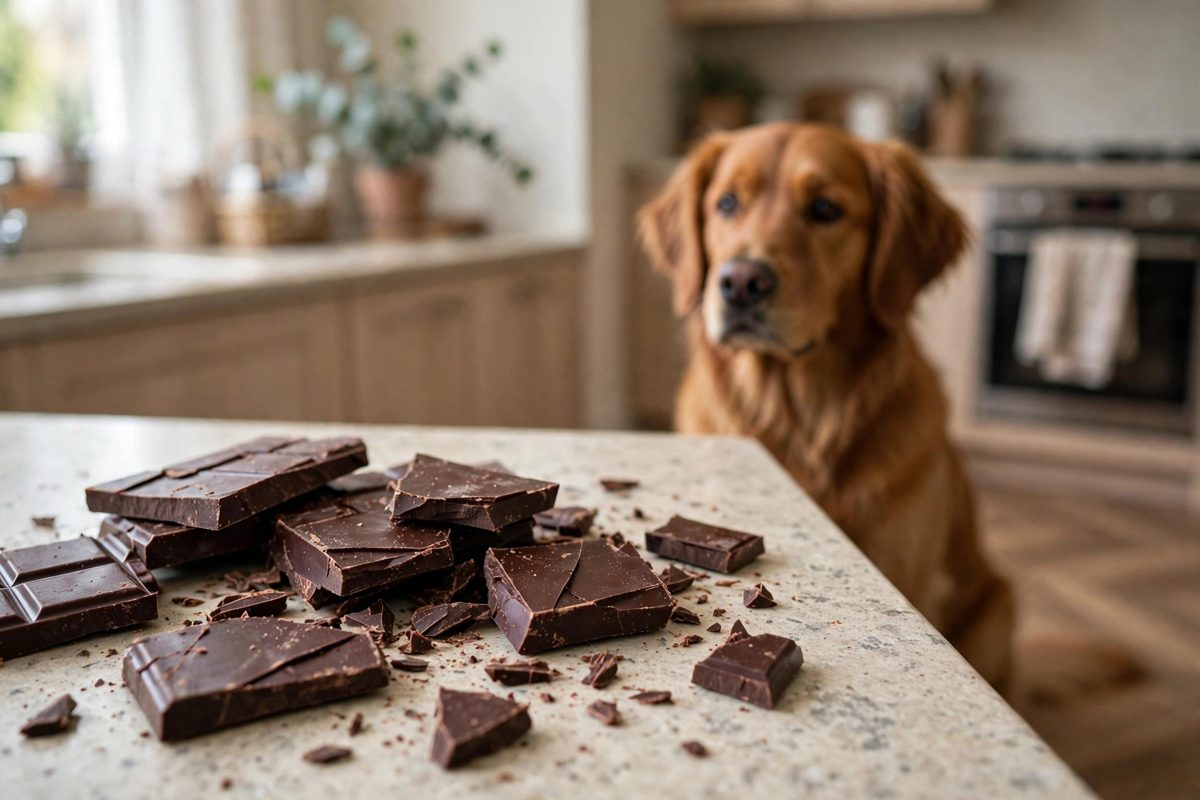
How much chocolate is dangerous for a dog?
It is the dose that matters, not the chocolate alone: the same bar is a small dose for a large dog and a large dose for a small one. Vets judge it in milligrams of chocolate poisons per kilogram of body weight, against these levels from the veterinary literature:
| Dose (per kg of body weight) | What is reported at this level |
|---|---|
| Under 20 mg/kg | Signs are not usually reported at this level — but it is never a “safe” verdict (see below) |
| 20 mg/kg and over | Mild signs: vomiting, diarrhoea, drinking much more than usual |
| 40–50 mg/kg and over | Heart effects: a racing or irregular heartbeat |
| 60 mg/kg and over | Seizures |
No row in that table is a safe row. The under-20 line only means signs are not usually reported there; the strength of a real product varies, wrappers and other ingredients can add their own problems, and a vet who hears from you early has far more options than one who hears late.
How does this calculator work?
Chocolate contains two related poisons, theobromine and caffeine. Theobromine is present at 3 to 10 times the caffeine level, but both contribute, so vets count them together as methylxanthines. The calculator multiplies the amount eaten by the strength of that chocolate type, then divides by your dog’s weight in kilograms to give the dose in mg/kg:
| Chocolate type | Per ounce | Per gram |
|---|---|---|
| Milk chocolate | 64 mg | 2.3 mg |
| Dark or semi-sweet chocolate | 150–160 mg | 5.3–5.6 mg |
| Baking / unsweetened chocolate | 440 mg | 15.5 mg |
| Cocoa powder | 807 mg | 28.5 mg |
| White chocolate | 1.1 mg | 0.04 mg |
For dark and semi-sweet chocolate the published strength is a range, so the calculator shows the dose as a range and judges the level by the higher end — the cautious reading.
Where these numbers come from: see our Sources page.
Worked example
The calculator’s pre-filled example: a 20 lb dog (about 9.1 kg) eats 2 oz of milk chocolate. At 64 mg per ounce that is about 128 mg of chocolate poisons, and 128 ÷ 9.1 = about 14 mg/kg — under the 20 mg/kg level where mild signs are usually reported. The advice is still to call the vet now: the amount is an estimate, and signs would take hours to show if the real dose were higher.
What are the signs, and when do they start?
Signs usually begin within 6 to 12 hours of eating the chocolate. Early signs are drinking much more than usual, vomiting, diarrhoea, a swollen belly and restlessness. As the dose rises, signs can progress to hyperactivity, urinating more, wobbliness, stiffness, tremors and seizures, and effects on the heart and breathing — a racing or irregular heartbeat, fast breathing and fever. In severe cases signs can persist for up to 72 hours. None of this is a wait-and-see list: if your dog has eaten chocolate, the call comes first.
Why are small dogs at higher risk?
The dose is worked out per kilogram, so the same piece of chocolate is a far bigger dose for a small dog than for a large one. A single ounce of baking chocolate is a mild event for a Labrador and a potential emergency for a Chihuahua. That is why even small amounts, especially in a smaller dog, should be treated as an emergency and reported to a vet.
Dog chocolate toxicity questions
My dog ate chocolate — what do I do?
Call your vet or an emergency animal clinic now, even if your dog seems fine: signs usually take 6 to 12 hours to appear. Tell them your dog’s weight, the type of chocolate and how much is missing. Keep the packaging. Do not try any home treatment, and do not wait to see if signs start.
How much chocolate can kill a dog?
The reported lethal range for the poisons in chocolate is about 100 to 200 mg per kg of body weight, but severe signs and death can occur at much lower doses, which is why vets treat far smaller amounts as emergencies. For milk chocolate, about 1 oz per pound of body weight is potentially lethal.
Is white chocolate dangerous for dogs?
White chocolate carries almost none of the poison — about 1.1 mg per ounce, a negligible amount next to milk chocolate’s 64 mg. It is the one type where the dose almost never reaches a danger level. Still tell your vet if your dog ate a lot of it, is very small, or is unwell for any other reason.
How long after eating chocolate do signs start?
Usually within 6 to 12 hours. Early signs include drinking more, vomiting, diarrhoea, a swollen belly and restlessness. In severe cases signs can persist for up to 72 hours, which is one reason vets want to hear from you early rather than late.
Is dark chocolate worse than milk chocolate for dogs?
Yes. Dark and semi-sweet chocolate carry about 150 to 160 mg of the poisons per ounce, against milk chocolate’s 64 mg. Baking chocolate (440 mg per ounce) and cocoa powder (807 mg per ounce) are far stronger again, so a small amount of those can be a large dose for a dog.
Why does the calculator give a range for dark chocolate?
Because the published veterinary figures for dark and semi-sweet chocolate are themselves a range (150 to 160 mg per ounce), and the strength of any real product also varies with the cocoa beans and the brand. The calculator shows the range and judges the level by the higher end — the cautious reading.
Other foods that are an emergency for dogs
Chocolate is not the only kitchen poison with no amount that is safe to work out at home. If your dog has eaten any of these, the advice is the same — call your vet or an emergency clinic first, then read:
- Dog Ate Grapes or Raisins — grapes, raisins and currants can cause kidney failure; the first signs usually appear within 6–12 hours.
- Dog Ate Xylitol — xylitol (birch sugar) in gum, mints and some peanut butters can crash a dog’s blood sugar within 30 minutes.
- Dog Ate Onion or Garlic — onion and garlic break down a dog’s red blood cells, and the signs often take days to appear.
- Dog Ate Ibuprofen — a human painkiller that can ulcerate a dog’s stomach and damage the kidneys; stomach signs can appear within 24 hours.
Next calculators you might need
Pet Water Intake Calculator
Daily water needs for dogs and cats, and the level that means a vet visit.
Live nowDog Weight Loss Calculator
A safe weekly target of 1–2% of body weight, with a calorie plan to match.
Live nowDog Food Calculator
How many cups a day, from your dog's weight and your food's calories per cup.
Live now