
Cat Food Calculator
Work out how much food your cat needs each day: daily calories from their weight and life stage, turned into cups, cans or grams.
Not sure if your cat is a healthy weight? Check first with the Cat Weight Calculator.
Want the money side of the bowl? The Cat Food Cost Calculator works out how long a bag lasts and what feeding costs per day, from your own label and the price you paid.
Quick answer: A typical 10 lb neutered indoor cat needs about 260 kcal a day — roughly ¾ of a cup of dry food at 350 kcal per cup, or about 1½ standard cans of wet food. Your cat's exact number depends on their weight, neuter status and your label; the calculator below works it out properly.
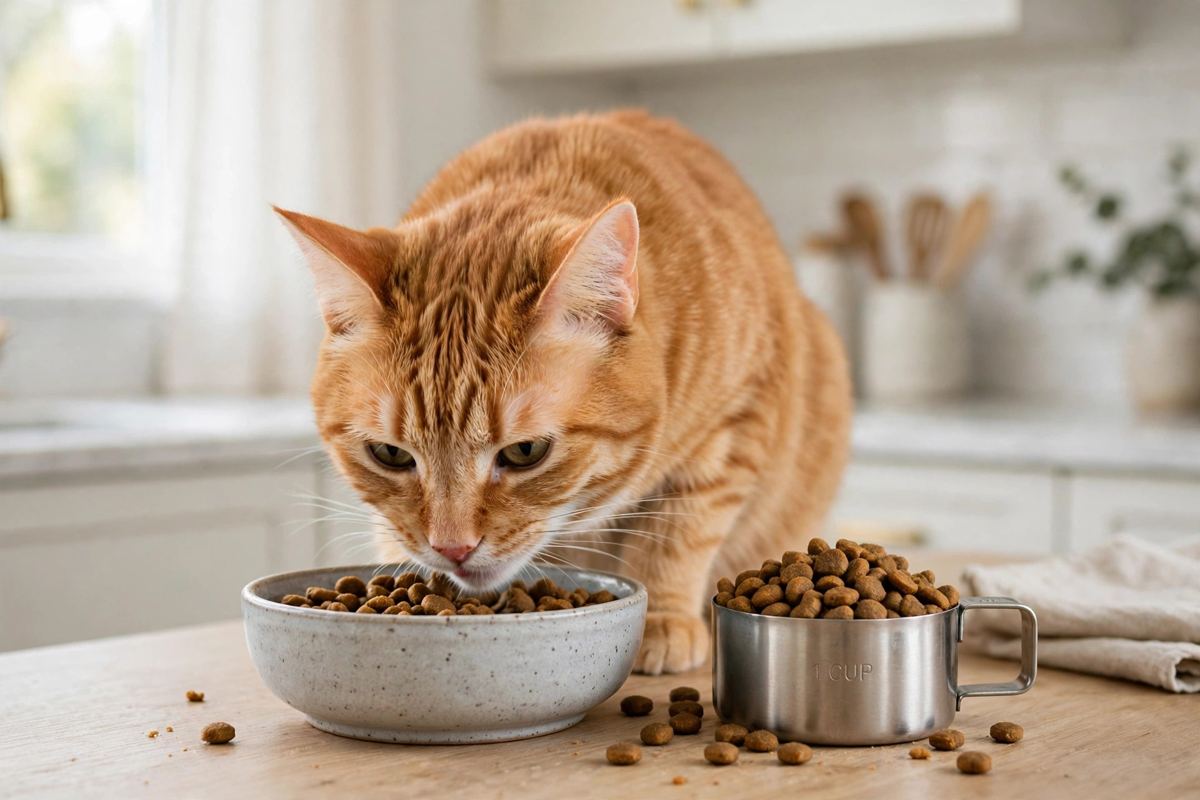
Why should you measure your cat's food in calories?
Cats run on calories, not scoops, and the same scoop can be a diet or a feast depending on the food. Cats are obligate carnivores. Their metabolism is built around protein and fat, and it handles carbohydrates poorly compared with a dog's. That is why the same "one scoop" thinking fails twice over with cats: the scoop hides the calories, and a food can hit the calorie number while skimping on the protein a cat actually needs. Use the calculator's number as your anchor, feed it as measured meals rather than an endlessly topped-up bowl, and then let body condition referee: ribs felt easily under a thin fat cover, a waist visible from above and from the side. Weigh monthly. A cat gaining or losing half a pound needs a small, early portion adjustment, not a crisis later.
How much should a cat eat by weight?
Daily calories for a neutered adult cat, converted at two example label values: a dry food at 350 kcal per cup and a wet food at 165 kcal per 5.5 oz can. Your label's numbers will differ; enter them above for an exact answer.
| Cat weight | RER (resting) | Daily calories × 1.2 | Dry cups at 350 kcal/cup | Wet cans (5.5 oz) at 165 kcal |
|---|---|---|---|---|
| 5 lb | 129 kcal | 155 kcal | 0.4 cups | 0.9 cans |
| 7 lb | 167 kcal | 200 kcal | 0.6 cups | 1.2 cans |
| 9 lb | 201 kcal | 241 kcal | 0.7 cups | 1.5 cans |
| 10 lb | 218 kcal | 261 kcal | 0.7 cups | 1.6 cans |
| 12 lb | 249 kcal | 299 kcal | 0.9 cups | 1.8 cans |
| 14 lb | 280 kcal | 336 kcal | 1.0 cups | 2.0 cans |
| 16 lb | 310 kcal | 371 kcal | 1.1 cups | 2.2 cans |
How does the cat food calculator work?
The calculator works in two steps: your cat's daily calorie needs first, then the calories per cup or can printed on your food's label.
The first half is your cat: resting energy (RER) from the standard formula, multiplied by the factor for their life stage. The second half is your food: the Calorie Content statement on the packaging, which lists kcal per cup for dry food and kcal per can for wet. We deliberately never guess a "typical" label value for you, because foods vary too widely for an average to be safe. The life-stage factors used are the standard veterinary values:
| Life stage | Factor (× RER) |
|---|---|
| Neutered adult | × 1.2 |
| Intact adult | × 1.4 |
| Inactive / weight-prone adult | × 1.0 |
| Weight loss (at target weight) | × 0.8 |
| Kitten (growth) | × 2.5 |
And the warning that travels with the formula applies to every result here: an individual cat may need up to about 30% more or less than the calculation gives. Feed the calculated amount for two to three weeks, weigh your cat, check their body condition, and adjust in small steps. Sources checked in November 2026.
Worked example
A 10 lb (4.5 kg) neutered adult cat: RER = 70 × 4.50.75 ≈ 218 kcal, so daily calories = 218 × 1.2 ≈ 261 kcal. On a dry food labeled 350 kcal per cup that is 261 ÷ 350 ≈ 0.7 cups a day, about a third of a cup at each of two meals. On a wet food at 165 kcal per 5.5 oz can, the same cat needs about 1.6 cans a day. Mixed feeding splits the difference: half the calories from each, for example one 5.5 oz can plus about ⅓ of a cup of dry.
Wet, dry, or mixed?
All three can work. What decides your cat's weight is the calorie total, not whether the food is wet, dry or a mix of both. Wet food's quiet advantage is water: at roughly 70–80% moisture it hydrates a cat who barely drinks, which matters for urinary health. Pair it with the water calculator if your cat is a reluctant drinker. Dry food is convenient and calorie-dense, which cuts both ways: portions look small because they are, and a careless scoop overfeeds fast. The popular claim that dry food cleans teeth is mostly a myth — ordinary kibble shatters on contact and does little for plaque. Many owners land on mixed feeding: wet food as the base, a measured amount of dry alongside. Whatever you choose, the calculator's number holds across all three.
How much wet food should I feed my cat?
About 1½ standard cans a day for a typical 10 lb cat fed wet food alone. The chart above, worked out at 165 kcal per 5.5 oz can, puts a 10 lb neutered adult at 1.6 cans a day, and the worked example lands on the same figure. The amount scales with weight: the same chart runs from 0.9 cans a day for a 5 lb cat up to 2.2 cans a day for a 16 lb cat.
The exact count depends on your cat's daily calorie target and on the can in your hand: divide the target by the kcal per can printed on the label. Can size changes the answer a lot — at about 260 kcal a day, that same cat needs around 2.4 small 3 oz cans (at ~110 kcal each) or just over 1 large 12.5 oz can — and wet foods range from under 100 to over 200 kcal per can at the same size, so your own label, not these examples, has the final say. Feeding a kitten instead? See when kittens can start eating wet food.
Where these numbers come from: see our Sources page.
Cat feeding questions
How much food should I feed my cat per day?
Work in calories first, portions second. A typical 10 lb neutered adult cat needs about 260 kcal a day. What that looks like depends entirely on the food: roughly three-quarters of a cup of a dry food labeled 350 kcal per cup, or about one and a half 5.5 oz cans of a wet food at 165 kcal a can. Same cat, same calories, very different-looking bowls — which is why this calculator starts from your label, not from a generic scoop.
How many cans of wet food should a cat eat a day?
Divide the daily calorie target by the kcal per can printed on your label. For the average 10 lb indoor cat at about 260 kcal a day: around 2.4 small 3 oz cans (at ~110 kcal each), about 1.6 standard 5.5 oz cans (at ~165 kcal), or just over 1 large 12.5 oz can if it were fed alone. Check your own can. Wet foods range from under 100 to over 200 kcal per can at the same size.
Why does my cat always seem hungry?
Some of it is wiring: cats are built to eat many small meals, and a twice-a-day bowl feels like a long gap to them. Some of it is the food: lower-protein, high-carbohydrate diets satisfy cats less than the protein-rich food their metabolism expects. And some is habit and boredom, especially in indoor cats. If hunger is new, constant and paired with weight loss, thirst or behavior change, that is a vet visit — overactive thyroid and diabetes both announce themselves that way in older cats.
Should I free-feed my cat or use set meals?
Measured meals suit most indoor cats better. Free-feeding dry food is the most common route to a quietly overweight cat, because the bowl never empties and nobody, including the cat, tracks the total. Set meals let you see exactly what was eaten, which is also how you notice early when a cat goes off their food, often the first sign of illness. If your cat grazes, measure the full day's portion into the bowl each morning instead of topping it up.
How much should I feed a kitten?
Kittens run at about 2.5 times resting energy while they are growing. A 3 lb kitten needs roughly 220 kcal a day, split across 3 to 4 small meals. Use the kitten setting on this page with your kitten's current weight, and re-run it every couple of weeks: a growing kitten's target climbs fast, and last month's portion is this month's underfeeding. Most kittens move to adult portions and twice-daily meals around their first birthday.
Do treats count toward my cat's daily total?
Yes. Treats, toppers and licks of your dinner all come out of the same daily budget. A sensible ceiling is about 10% of the day's calories on treats: for an average indoor cat that is roughly 25 kcal, which disappears faster than owners expect — a few commercial treats or a small piece of chicken. If treats are a big part of your routine, trim the meals slightly to make room rather than adding treats on top.
Next calculators you might need
Pet Calorie Calculator
Daily calories (RER × life-stage factor) for dogs and cats.
Live nowCat Litter Calculator
Monthly litter use and cost from your box, your litter type and your bag price.
Live nowPet Water Intake Calculator
Daily water needs for dogs and cats, and the level that means a vet visit.
Live nowFeeding a dog too? The Dog Food Calculator works the same way for dogs. See the Feeding & Nutrition hub for every feeding tool.
Cat food safety guides
Before you share a bite of your own food, check it here: the people foods owners ask about most, what is safe, what is not, and how much fits the treat budget this calculator works to.
Can Cats Eat Bananas?
Banana is non-toxic to cats — the bite-sized serving, the under-10% treat rule behind the Cat Food Calculator, and the people foods that really are dangerous.
Read the guideCan Cats Eat Cheese?
Not toxic, but dairy — why many cats cannot digest lactose, and why a one-inch cube of cheddar spends about three days of treat budget.
Read the guideCan Cats Eat Eggs?
Cooked, yes; raw, no — the bacteria and avidin that make raw egg a different food, and how much cooked egg fits the treat budget.
Read the guideCan Cats Eat Dog Food?
A stolen bite is harmless, a diet is not: the taurine, vitamin A and protein a cat needs that dog food does not provide, and what happens over time.
Read the guideCan Cats Eat Peanut Butter?
Not toxic, but one tablespoon is about four days of treat budget — what to check on the label, and the xylitol note for homes with dogs.
Read the guideCan Cats Eat Strawberries?
Listed as non-toxic to cats and light at about 4 kcal a berry — how many fit the treat rule, and how to serve them.
Read the guide