
Puppy Weight Calculator
How big will your puppy get? Enter today's weight, age and size class to predict the adult weight.
Planning shots as well as growth? Date every round with our Puppy Vaccination Schedule Calculator.
Not sure which size class your breed belongs to? The Dog Breed Size Calculator lists the standard adult weight for 50 breeds.
Quick answer: Divide your puppy's weight by the share of adult weight typical for their age and size. A 12-week medium puppy is about 35% grown, so 9 lb ÷ 0.35 ≈ 26 lb as an adult. Small breeds grow up fast, giant breeds slowly — the calculator adjusts for both.
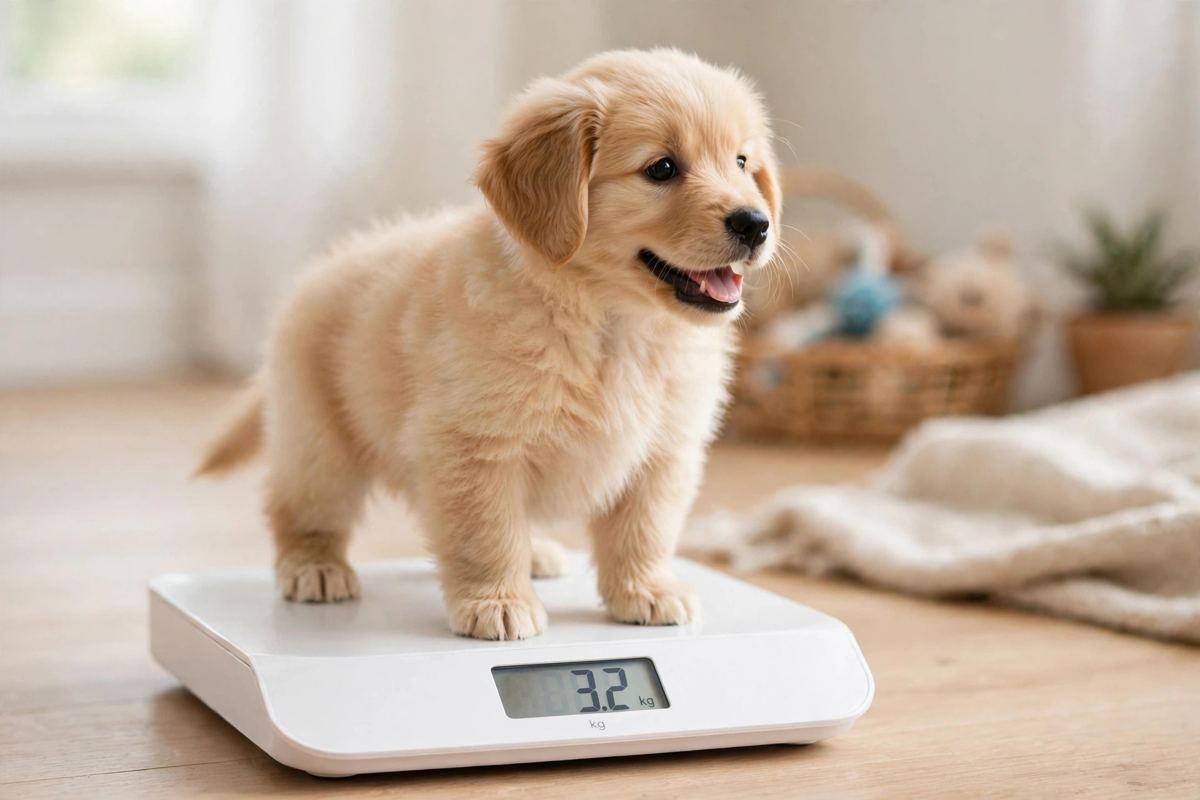
What does the predicted weight mean?
Treat the result as a planning estimate. Puppies grow along a curve that starts steep and flattens out, and the curve's shape depends on size. A toy puppy races through growth and is nearly finished while a giant-breed puppy of the same age has barely started, so a useful prediction has to use both the age and the size class. Use the number to choose the right crate size, budget food and spot growth running far ahead of or behind the curve at a vet visit. Genetics, litter size, nutrition and neutering all nudge the final figure, which is why the answer always comes with a range.
What share of adult weight has my puppy reached?
The share of final adult weight a puppy has typically reached at each age. Find your puppy's row and column, then divide today's weight by that share, or let the calculator above do it, including the ages in between.
| Age | Toy | Small | Medium | Large | Giant |
|---|---|---|---|---|---|
| 8 weeks | 31% | 26% | 22% | 16% | 12% |
| 12 weeks | 44% | 39% | 35% | 28% | 23% |
| 16 weeks | 59% | 54% | 49% | 41% | 35% |
| 20 weeks | 71% | 66% | 62% | 54% | 48% |
| 24 weeks | 81% | 77% | 74% | 66% | 59% |
| 36 weeks | 100% | 95% | 92% | 88% | 82% |
| 52 weeks | 100% | 100% | 99% | 96% | 94% |
Two landmarks worth remembering: half of adult weight arrives at about 3 months for a toy puppy but not until about 5 months for a giant one. A giant puppy at its first birthday is still only about 94% grown.
How does this calculator work?
The shares are calculated from published veterinary growth-curve research covering millions of young dogs seen at US vet clinics, grouped into size classes. That research publishes its curves as charts rather than a percentage table, so the percentages here are derived from the curves, and every prediction is given as a range for that reason. The calculator finds your puppy's age on the curve for their size class (interpolating between the chart points), divides, and then wraps the answer in a range that matches how predictable puppies of that age really are: about ±15% under 16 weeks, ±12% from 16 to 26 weeks, and ±8% after that. It also projects the checkpoints owners actually plan around (expected weights at 16, 20, 26, 39 and 52 weeks) from the same curve. This calculator is based on growth data for dogs up to about 88 lb (40 kg) adult weight. For bigger breeds, ask your vet to track growth.
Worked example
A medium-breed puppy weighs 9 lb at 12 weeks. The chart says a medium puppy at 12 weeks has reached about 35% of adult weight, so 9 ÷ 0.35 ≈ 26 lb. At 12 weeks the range is ±15%, giving about 22–30 lb, comfortably inside the medium band. The same puppy should weigh roughly 13 lb by 16 weeks and about 20 lb by 26 weeks; if real weigh-ins track those checkpoints, the prediction is holding.
Where these numbers come from: see our Sources page.
When do puppies stop growing?
Toy and small breeds finish first, reaching adult weight at roughly 8–12 months. Medium breeds take about 12–14 months, large breeds 15–18 months, and giant breeds can keep adding weight until 18–24 months. Height stops before weight does. The growth plates close and the frame is set while the dog is still filling out with muscle. That long, slow finish is exactly why giant-breed puppies need growth watched rather than pushed: growing too fast on too much food is harder on developing joints than growing slowly.
When should a vet check my puppy's growth?
Weigh your puppy every two weeks (most vet clinics will let you use their scale free) and plot the numbers against the checkpoints above. Book a visit if growth stalls for more than a couple of weeks, if your puppy is gaining far faster than the curve, or if ribs disappear under fat or, at the other extreme, every rib and hip bone shows. Puppies should look softly rounded, never roly-poly and never bony. Any sudden change in appetite, energy or stool alongside odd growth is a vet question, not a calculator question.
Puppy growth questions
How big will my puppy get?
It depends mostly on size class. A puppy grows along a curve: at any age they have already reached a typical share of their adult weight, and that share is bigger for small breeds (who grow up fast) than for giant breeds (who grow slowly for up to two years). This calculator divides today's weight by the share for your puppy's age and size class. A 12-week-old medium puppy at 9 lb, for example, has reached about 35% of adult weight: 9 ÷ 0.35 gives an adult weight of about 26 lb.
How accurate is a puppy weight calculator?
It gives a range, not a promise. Young puppies are the hardest to predict, so the range here is widest under 16 weeks (about ±15%), narrows to about ±12% between 16 and 26 weeks, and to about ±8% after that. Mixed breeds vary more than purebreds, and a puppy who was the runt or the giant of the litter can land outside the range. Weighing every couple of weeks and watching the trend beats any single estimate.
Does paw size predict adult weight?
Only loosely. Big paws often belong to a puppy with a big frame to grow into, which is why the saying exists. But paws are not a measuring tool. Some breeds carry oversized paws on a medium adult body, and plenty of large adults had unremarkable puppy paws. Current weight, exact age and size class predict far better than paws do, which is why this calculator uses those three.
When do puppies stop growing?
Small breeds finish first. Most toy and small dogs are at or near adult weight by 8 to 12 months. Medium breeds take about 12 to 14 months, large breeds 15 to 18 months, and giant breeds can keep filling out until 18 to 24 months. Height usually stops before weight does: a young dog can look finished while still adding muscle and body mass for months.
What if I don't know my puppy's size class?
Use the parents if you know them. A puppy usually lands somewhere near the average of mother and father, and the parents' adult weights tell you the class. If the parents are unknown, pick the class that matches the adult weight your vet expects, then try the class either side as well: where the two estimates overlap is a sensible planning range for food, crates and costs.
Why not just double the weight at 16 weeks?
Because that old rule only roughly fits medium puppies. Doubling the 16-week weight overestimates most small breeds (a toy puppy is already well past half grown at 16 weeks) and underestimates giant breeds (who are barely a third grown). The share-of-adult-weight method adjusts for both age and size class, which is why it holds up better across the whole range from a 5 lb toy to an 88 lb giant.
Next calculators you might need
Dog Food Calculator
How many cups a day, from your dog's weight and your food's calories per cup.
Live nowDog Crate Size Calculator
The right standard crate size from two measurements of your dog.
Live nowDog Age Calculator
Human years by adult size, with the full size chart and a DNA-based second view.
Live nowMore growth tools are on the way in this hub, and the Kitten Age Calculator is next. See the Age & Growth hub for the full list.